Friday, 19 July 2013

Agnieszka Radwanska responds to Body Issue controversy

The Polish tennis star was dropped by a Catholic youth group.


Tennis star Agnieszka Radwanska broke her silence about the uproar in her native Poland about her nude photo shoot for ESPN The Magazine’s Body Issue. Earlier this week, Radwanska was dropped from a Catholic youth group for her “immoral behavior.”

The following statement was posted Friday on her Facebook page.

    “For those that are not familiar with the magazine, ESPN The Body Issue is a celebration of the beauty of the bodies of the best athletes in the world. It includes both men and women of all ages and all shapes and sizes. Other athletes photographed include San Francisco quarterback Colin Kaepernick, 77-year-old golf legend Gary Player, and Olympic volleyball gold medalist Kerri Walsh Jennings – during and after her pregnancy. My tennis colleagues Serena Williams, Daniela Hantuchova and Vera Zvonareva have all participated in the past.

    The pictures are certainly not meant to cause offense and to brand them as immoral clearly does not take into account the context of the magazine. Moreover, they do not contain any explicit imagery whatsoever. I train extremely hard to keep my body in shape and that’s what the article and the magazine is all about. If you read the interview, it only discusses my job as an athlete and what I have to do physically to be able to participate at the highest level of sport.

    It has been suggested by some members of the press (among others) that I was paid for the photo shoot. This is absolutely not the case. Neither I nor any of the other athletes were paid. I agreed to participate to help encourage young people, and especially girls, to exercise, stay in shape and be healthy.”

This was the right tone for a statement. Note that she doesn’t apologize, nor show contrition. She explains her thought process and intentions.

Radwanska could have been stronger in her rebuke of the morality police who insinuated she was a bad role model for young women, but given the outrage in Poland, she played it well.


Norwegian convicted over rape report issues Gulf caution

Interior designer appealing 'very harsh' sentence for illicit sex after she reported being raped by a co-worker.

The Norwegian interior designer convicted in Dubai of having illegal sex after she reported being raped is appealing her jail sentence and alerting Western women to the Islam-based legal system of the United Arab Emirates.

"I just want to get fair treatment," Marte Deborah Dalelv, 24, told the AFP news agency Friday. She called her 16-month sentence Tuesday — for extramarital sex, perjury and illegal alcohol consumption — "very harsh," saying she had appealed immediately. A hearing is set for Sept. 5.
Since the Norwegian government secured Dalelv's conditional release after she was charged in March, she has been living under the protection of the Norwegian Seamens' Center, a church in Dubai. But now that she has been sentenced, she told Norway's NRK News that she is officially wanted by the authorities, the BBC reported.

"I should have been imprisoned since Tuesday," she said. "But I have been told they are not searching for me."

She told AFP she was "very nervous and tense."

"I hope for the best, and I take one day at a time," she said by telephone. "I just have to get through this."

Nonetheless, Dalelv stressed she did not want to criticize the UAE government.

"They have their legal system," she said.

Under United Arab Emirates law, sex outside of marriage is illegal, and a rape conviction requires either a confession or four adult male witnesses to the attack. Similar convictions involving foreigners and Emirati women have occurred over the past several years, although the law on extramarital sex is not generally enforced for tourists or several hundred thousand Westerners and others living there on resident visas.

Marte Dalelv was sentenced to 16 months in jail for extramarital sex, perjury and consuming alcohol without a license. She was charged after reporting in March that a co-worker had raped her in a Dubai hotel where she was attending a business conference.

In an interview with the Associated Press, Dalelv said she wanted to "spread the word" about significant differences in the emirates' legal code compared with Western legal systems.

"After my sentence we thought, 'How can it get worse?'" she said from the church. She has been in regular contact with her family, who live outside of Oslo.

Explaining the March 6 attack at a hotel where she was attending a business conference, Dalelv said she awoke to find a co-worker raping her. She fled to the lobby to report the assault, and said the staff questioned whether she wanted to involve the police.

After questioning and a medical examination, she wound up being jailed for four days, charged and having her passport confiscated.

Dalelv said her attacker was sentenced to 13 months for extramarital sex and consuming alcohol without a license.

She also revealed that she was suspended by Qatar-based home-furnishings company The One after her arrest, according to media in Norway, where her case has dominated the news and sparked outrage.

She told NRK that her suspension letter cited "gross misconduct on the job in direct violation of the company's policy" and the firm wants to fire her.

In response, Norwegian colleges cut their ties with The One, which has recruited students from across Scandinavia to come work in the Gulf, The Local reported.

Dubai authorities have not responded or issued any public statements about her case.

Foreign Minister Espen Barth Eide said was trying to reach his counterpart in the Gulf nation, but communications were slowed by Ramadan and Friday, Islam's holy day.

Thursday, the Norwegian Department of Foreign Affairs said the verdict "flies in the face of our notion of justice" and was "highly problematic" in terms of Western human rights.

Westerners often misunderstand Dubai, a cosmopolitan Arabian Gulf city-state boasting the tallest building in the world and glamorous malls.

"It can seem modern here, and the comfort level is high," one Norwegian resident told NRK. "But it's a Muslim country, and folks must realize that before they travel."

Noting the influence of Sharia law, he added, "In reality, there are completely different rules that apply, completely shocking rules."

Legal battle brews over Detroit bankruptcy filing

The city's emergency manager says that pension and health care benefits are safe for at least the next six months.

The city's emergency manager says that pension and health care benefits are safe for at least the next six months.

DETROIT -- While Detroit emergency manager Kevyn Orr on Friday was offering short-term reassurances to thousands of city pensioners whose benefits are in jeopardy, his lawyers were waging a whirlwind legal battle over the constitutionality of the bankruptcy filing that could land both sides before a federal judge early next week.

On Friday, Michigan Attorney General Bill Schuette said he will appeal an Ingham County judge's ruling that Detroit's bankruptcy filing must be withdrawn because it violates the Michigan Constitution and state law.

However, the order from Ingham County Circuit Judge Rosemarie Aquilina ultimately could have little effect because the bankruptcy case already was filed in federal court, and federal law generally trumps state law. The city filed a motion requesting to include the state as a party in the bankruptcy code's provisions that put on hold all lawsuits against the city, a clear attempt to fight the Ingham County ruling by preventing the state from being sued in similar fashion. The city is asking U.S. District Judge Steven Rhodes to hold a hearing on Tuesday, or earlier, to decide this and other matters.

Friday's legal wrangling marks the beginning of what is expected to be a lengthy bankruptcy process that will involve more than 100,000 creditors, which include the Police and Fire Retirement System and the General Retirement System and its 20,000 retirees.

Orr provided retirees some temporary relief Friday, telling the Detroit Free Press that pension and health care benefits are safe for at least the next six months.

"We have made a decision that for the balance of this year, the next six months, we're not touching pension or health care," Orr said in an interview with Free Press editors and reporters. "So all pensioners, all employees you should understand: It's status quo for the next six months."

The announcement was welcome news to Thomas Berry of Livonia, who retired from the Detroit Police Department six years ago after more than 34 years on the job.

"I think that's huge," Berry said. "You've given me five months to evaluate. We're going to sock away more and maybe spend a lot less."

Orr has not yet specified the cuts to pensions he will seek through the bankruptcy process. He has proposed freezing pensions and moving workers to a 401(k)-style plan to help alleviate the pension systems' unfunded liabilities of $3.5 billion. He also wants to move retirees to Medicare or health care exchanges being set up through the Affordable Care Act.

Orr, alongside Michigan Gov. Rick Snyder, spent Friday in a series of public appearances and meetings explaining why it was necessary for Detroit to file for bankruptcy protection and how the lengthy process is likely to affect the city's residents, workers and retirees. The duo stressed bankruptcy was long overdue, and is the best path to resolve the city's liabilities of about $18.5 billion. They said services to residents will improve.

Orr said the lawsuits from pension boards and others didn't spur the filing. He said he was simply running out of time.

"We're dealing with 60 years of deferred maintenance in 18 months," Orr said during a news conference at Wayne State University, referring to the length of time in which he'll oversee the city.

Still, Orr singled out retirees and pension fund lawsuits filed in recent days to try to stop the state-approved bankruptcy filing, based on the argument that the state's constitution prevents the city or state from cutting protected pension benefits for retirees. Orr deflected criticism from union leaders and pension officials that he wasn't bargaining in good faith in recent weeks, citing lawsuits opponents filed.

"That's the very thing I had pleaded for not to happen," said Orr, standing next to Snyder. "Anyone who thinks I wasn't negotiating in good faith, when they're suing me, look at that context."

In a spate of orders out of Ingham County Circuit Court arising from three separate lawsuits, Aquilina said Snyder and Orr must take no further actions that threaten to diminish the pension benefits of city of Detroit retirees.

"I have some very serious concerns because there was this rush to bankruptcy court that didn't have to occur and shouldn't have occurred," Aquilina said.

Lawyers representing pensioners and two city pension funds got an emergency hearing with Aquilina on Thursday at which she said she planned to issue an order to block the bankruptcy filing. But lawyers and the judge learned Orr filed the bankruptcy petition in Detroit five minutes before the hearing began.

Aquilina said the Michigan Constitution prohibits actions that will lessen the pension benefits of public employees, including those in the city of Detroit. Snyder and Orr violated the constitution by going ahead with the bankruptcy filing, because they know reductions in those benefits will result, Aquilina said.

"We can't speculate what the bankruptcy court might order," said Assistant Attorney General Brian Devlin, representing the governor and other state defendants.

"It's a certainty, sir," Aquilina replied. "That's why you filed for bankruptcy."

Devlin said Snyder has to follow both the Michigan Constitution and the U.S. Constitution.

Report: Statistician, blogger Nate Silver to join ESPN

The Times is reporting Silver is taking his FiveThirtyEight franchise to ESPN.


The New York Times is reporting that Nate Silver is leaving The Times to join ESPN.

Silver, 35, is the statistician who gained notoriety for devising algorithms which accurately predicted the 2008 and 2012 presidential races. Silver is taking his FiveThirtyEight franchise to ESPN, where he will have a prominent role on the new Keith Olbermann show. Silver will also appear on ABC News during election cycles, according to Brian Stelter at the New York Times.

The Times brought in Silver and FiveThirtyEight in August 2010, but that contract is expiring, allowing ESPN to pick up the franchise and giving Silver an on-air platform in addition to his popular blog. There are reports that Silver may also have a role with ABC News during election years.

Silver's blog was a big traffic driver for The Times. New Republic reported in November that just before the 2012 presidential election FiveThirtyEight accounted for about 20% of the overall visits to the New York Times website.

Silver made his mark as a baseball statistician before joining The Times.

Indiana halts vanity license program

A lawsuit challenged the program after the state Bureau of Motor Vehicles rejected a police officer's request to renew his plate that read "0INK."

INDIANAPOLIS -- Indiana motorists who want a vanity plate will have to put their plans on idle until a lawsuit over an "0INK" plate is settled.

State Bureau of Motor Vehicles Commissioner Scott Waddell said late Friday that the personalized license plate program will be temporarily suspended, pending the outcome of the legal case.

Those who already have personalized plates can keep them, and even renew them. But anyone else who fancies a plate that tells the world "IMGR8" or "UR2CLOS" will just have to "W8."

Waddell, in a statement, blamed the suspension of the plate program on the legal challenge, saying it is necessary "in order to protect Hoosier taxpayers from the considerable expense that these types of lawsuits bring."

It's the latest in a series of legal complications for the BMV. Earlier this month, it had to agree to repay Hoosiers after overcharging for driver's licenses. Last month, after an extended legal battle, it agreed to restore the specialty plate for the Indiana Youth Group, which supports gay, bisexual, transgender and sexually questioning youth.

The lawsuit that prompted the BMV to park the vanity plate program was filed in Marion County Superior Court in May by the American Civil Liberties Union of Indiana on behalf of a Greenfield policeman, Rodney Vawter.

For three years, Vawter had a license plate that read "0INK" — with a zero in place of the O — but when he tried to renew it in March, it was rejected.

The lawsuit says Vawter considers the plate's verbal pig snort "an ironic statement of pride in his profession."

"Corporal Vawter selected the phrase 'oink' for his license plate because, as a police officer who has been called 'pig' by arrestees, he thought it was both humorous and also a label that he wears with some degree of pride," the lawsuit states.

The BMV this year told Vawter the plate was inappropriate, and cited a state statute that allows the BMV to refuse to issue a plate that officials believe carries "a connotation offensive to good taste and decency" or "would be misleading."

Ken Falk, legal director for the ACLU, said that statute should be deemed an unconstitutionally vague infringement on free speech. And he called Friday's suspension of the BMV program "curious."

"I don't understand that," Falk said. "This (suspension) in no way affects the lawsuit, so I'm not sure what the BMV is saving in expenses. The lawsuit that we have challenges not the PLP program; it challenges the standards by which plates are assessed and the fact that apparently the BMV is using standards" which are not spelled out in law or code.

Waddell, in his statement, said the personalized plate program is one of the BMV's oldest.

"Indiana is not the first state to see its PLP statutes challenged, as this has become a widespread topic of debate across the nation," he said.


Monday, 8 July 2013

NTSB looks at Asiana pilot's lack of 777 experience


The experience of the pilot at the controls of Asiana Airlines Flight 214 could be a factor in the investigation of Saturday's crash of the Boeing 777, according to federal crash investigators.

Lee Gang Guk had spent just 43 hours flying the 777, and was accompanied by a deputy pilot more familiar with the jet to assist him, according toAsiana Airlines.

By U.S. standards, Lee's limited time flying a 777 would have also likely required him to have a more experienced peer in the cockpit. Generally, when a pilot has been flying a new jet for roughly 100 hours or less, they must have either a more experienced captain or co-pilot present to observe, guide, or help them, said Kit Darby, a former United Airlines pilot who now provides simulator training.

There were three other pilots on board Asiana Airlines Flight 214, including the deputy pilot Lee Jeong Min, who had spent 3,220 hours flying 777s, according to the Associated Press, quoting the Ministry of Land, Infrastructure and Transport in South Korea.

Although Lee was a newcomer to the 777, he had clocked nearly 10,000 hours piloting a variety of other jets.

"He wasn't a novice,'' said Les Westbrooks, a former commercial airline pilot who is an associate professor of aeronautical science at Embry-Riddle Aeronautical University in Daytona Beach, Fla. "He was new to this particular plane, but he was a very experienced pilot.''

Federal crash investigators were to speak to the pilots Monday as part of the inquiry into why the Asiana crash occurred, leaving two dead and scores injured.

Deborah Hersman, chairwoman of the National Transportation Safety Board, was asked about the pilot's experience on different aircraft and his transition to the 777, but she said she didn't want to influence the interviews with the flight crew.

"We don't want to influence the responses," she said at a news briefing Monday. Those interviews are expected to give investigators a clearer picture of what was going on inside the cockpit and how they were reacting.

NTSB officials said that the ill-fated flight slowed far more than the pilot intended before crashing, but it's not clear yet from the flight-data recorder how the speed affected the plane's descent into San Francisco International Airport.

Pilots disengaged the autopilot when the Boeing 777 was 1,600 feet in the air, about 82 seconds before the crash Saturday, according to Hersman.

The targeted speed for landing was 137 knots, Hersman said.

At 125 feet above ground, eight seconds before impact, the plane's throttle began moving forward, Hersman said.

She had previously indicated from the cockpit voice recording that at seven seconds from impact, the crew recognized their speed was slow; at four seconds, equipment sounded an alarm warning of the potential to stall; and at 1.5 seconds, a crewmember said to abort the landing and circle the airport for another try.

At three seconds before impact, the plane reached its lowest speed of 103 knots, with engine power increasing, and it crashed at 106 knots, Hersman said.

"This aircraft was significantly slower than their target approach speed of 137 knots," which is the speed they wanted to reach the end of the runway, Hersman said.

Westbrooks said that landing too slow is an error that pilots learn from their first flying lesson to try to avoid.

"It is the most fundamental thing that you learn in flying . . . to not get slow like this,'' Westbrooks said. "Once we get real slow, the flow of the air over the wings starts to break apart, and it doesn't flow over smoothly, and we start losing our lift.''

Darby said that the dramatic slowdown may have resulted from the pilot trying to correct himself.

"He probably started high and fast and ended up . . too low and slow,'' Darby said.

Saturday's accident occurred during Lee Gang Guk's first time landing a 777 at San Francisco International Airport, according to Asiana Airlines.

Darby said that some airports require special training, for instance if the pilot has to navigate mountainous terrain. Although San Francisco doesn't fall into that category, Darby said there were some characteristics and circumstances that might have made landing more difficult.

"There are some things about San Francisco that make it demanding,'' Darby said. Flying over water as you approach can make it harder for pilots to get a feel for how fast they're going, he said.

Also, on Saturday, the "glide slope" or radio beam that electronically helps an airplane descend at the proper angle wasn't available. Incoming planes would have been made aware of that, Darby said, and an alternate guide visible through the cockpit window would have sufficed.

Nevertheless, he said, "the combination of that missing beam and coming in over the water is a real risky combination.''

As the investigation continues, Westbrooks cautioned that there is seldom a single misstep or malfunction that causes a plane crash.

"Not just one thing happens,'' he said. "It's a chain of events that build up to it.''


Asiana pilot was on a training flight

The pilot tried to abort the landing 1.5 seconds before crash.


SAN FRANCISCO — Asiana Airlines says the pilot of the ill-fated Boeing 777 that crashed Saturday had little experience flying the aircraft and was landing one for the first time at San Francisco International when it slammed into the runway, killing two teenage passengers and injuring more than half the 307 passengers and crew.

Airline spokeswoman Lee Hyomin said Monday that Lee Gang Guk, who was at the controls of Saturday's nearly 10 1/2 hour flight from Seoul as it arrived at SFO, was a veteran pilot with nearly 10,000 hours flying other planes. But he had only 43 in the 777, a jet she said he still was getting used to flying.

Lee had flown Boeing 747 jets into San Francisco International previously and was assisted on this flight by deputy pilot Lee Jeong Min. The deputy had about 12,390 hours of flying experience, including 3,220 on the 777.

National Transportation Safety Board Chairman Deborah Hersman said Lee Gang Guk was flying with a supervisory training captain, another captain and a first officer. It was his ninth training flight on a 777, she said.

The revelations came on a day San Francisco Fire Chief Joanne Hayes-White said it was "a possibility" that one of the teens survived the crash but was killed on the tarmac by an emergency vehicle driven by one of the first responders at the scene.

"One of our fire apparatus may have come into contact with one of our two victims who was at the scene," Hayes-White said. "I assure you we are looking closely at this."

San Mateo County Coroner Robert Foucrault said that while autopsies of the two Chinese girls have been completed, he doesn't plan to release his findings on cause of death for another two or three weeks, after completion of tests.

"This is a very high-profile case and has obviously generated a lot of attention," Foucrault said. "I want to make absolutely sure my conclusions are correct."

The two teens, Ye Mengyuan and Wang Linjia, were from China's eastern Zhejiang province and were among 29 middle-school students and five teachers heading for a three-week church summer camp in Los Angeles. Both were declared dead at the accident scene. The body of the one who may have been struck by the emergency vehicle was found about 30 feet from the aircraft.

The fatalities are the first of a commercial airliner in the USA since February 2009. Remarkably, all but two of the 291 passengers and 16 crew survived. At least 168 people were treated for injuries. Eight remained in critical condition Monday.

At a news briefing Monday morning, firefighters described descending upon a harrowing scene Saturday morning and a swift, heroic rescue operation.

Tom Siragusa, an assistant San Francisco Fire Department chief, said rescuers twice entered the smoke-filled, burning aircraft to search for survivors while navigating crash debris and leaking jet fuel. The top priority was getting people off the jet, Siragusa said. "Everyone rose to the occasion, and I couldn't be prouder of everyone in my department,'' Siragusa said.

Other fire department officials say Asiana crewmembers pleaded for knives to help free trapped passengers.

"It just seemed to be surreal, like it wasn't happening," Lt. Dave Monteverdia said. Rescuers' "only way up" to reach the victims was via the plane's emergency chutes deployed after the crash, he said. Lt. Christine Emmons said that after she and a partner ran up the chute, they pulled out four passengers trapped in the back.

Hersman said earlier that Flight 214 was traveling far below its target speed for landing when it crashed short of the runway Saturday. "The speed was significantly below 137 knots, and we're not talking a few knots," she said.

The flight originated in Shanghai before stopping in Seoul en route to San Francisco. It carried 61 U.S. citizens, 77 South Koreans and 141 Chinese.

South Korean officials say pinpointing an exact cause of the crash may take months or years. "We cannot conclude the accident was caused by a pilot mistake. Whether there was a pilot mistake can be confirmed after all related data are analyzed and inspected," said Choi Jeong Ho, the head of South Korea's Transport Ministry Aviation Policy Bureau.

Hersman said investigators will look at all possibilities for the cause of the crash, including pilot error. "Everything is on the table," she said. Flight data and recorders have been recovered and will be examined by investigators, she said.

She provided details of what investigators found in their initial review of the jet's flight data and cockpit voice recorders: "The approach proceeds normally as they descend. There is no discussion of any aircraft anomalies or concerns with the approach. A call from one of the crewmembers to increase speed was made approximately seven seconds prior to impact."

The "stick shaker," which gives an audible and motion signal warning that the jet is flying too slowly and is about to stall, sounds "approximately four seconds prior to impact."

The pilot requested a "go-around" — to abort the landing, fly around the airport and try again, Hersman said.

"A call to initiate a go-around occurred 1.5 seconds before impact," she said.

Cabin manager Lee Yoon Hye, 40, said she has nearly 20 years' experience with Asiana and knew seconds before impact that something was wrong.

"Right before touchdown, I felt like the plane was trying to take off. I was thinking, 'What's happening?' and then I felt a bang," Lee said. "That bang felt harder than a normal landing. It was a very big shock. Afterward, there was another shock, and the plane swayed to the right and to the left."

Lee said crewmembers deflated the emergency slides with axes to rescue a colleague who seemed to be choking beneath the weight of a slide.

One flight attendant put a scared elementary schoolboy on her back and slid down a slide, Lee said. A pilot helped another injured flight attendant off the jet after passengers escaped.

Lee, who suffered a broken tailbone, said she worked to put out fires and usher passengers to safety in the harrowing moments after the jet went down.

Lee said she tried to approach the back of the aircraft before she left to double-check that no one was left inside. A cloud of black, toxic smoke made it impossible. "It looked like the ceiling had fallen down," she said.

Vedpal Singh, who was sitting in the middle of the aircraft and survived the crash with his family, said there was no warning from the pilot or any crewmembers before the jet touched down hard and he heard a loud sound.

"We knew something was horrible wrong," said Singh, who suffered a fractured collarbone and had his arm in a sling. "It's miraculous we survived."

Passenger Benjamin Levy, 39, said it looked to him as though the jet was flying too low and too close to the bay as it approached the runway. Levy, who was sitting in an emergency exit row, said he felt the pilot try to lift the jet up before it crashed and thinks the maneuver might have saved some lives.

"Everybody was screaming. I was trying to usher them out," he recalled of the first seconds after the landing. "I said, 'Stay calm, stop screaming, help each other out, don't push.' "

At least 51 killed in Egyptian clashes

Pro-Morsi supporters say security forces fired on them; the army claims people stormed a military building in Cairo.

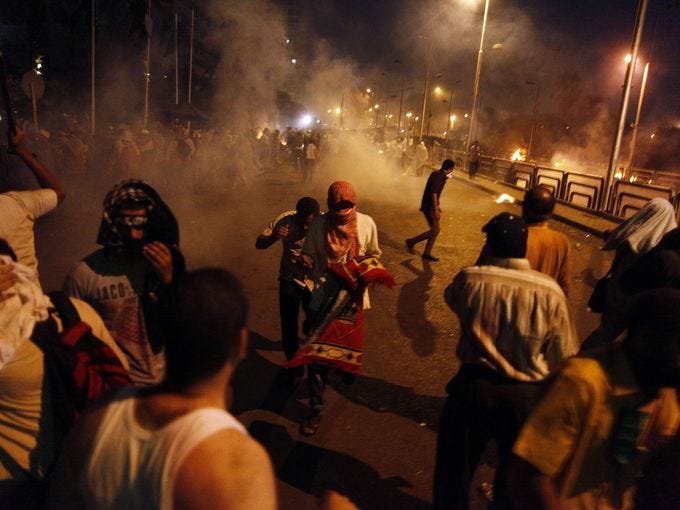
CAIRO — At least 51 people were killed and more than 300 injured when Egyptian soldiers and police clashed with Islamists early Monday at a sit-in by supporters of former Egyptian president Mohammed Morsi, raising the specter of civil war.

Interim leader Adly Mansour issued a statement Monday expressing "deep sorrow" over the deaths and calling for self-restraint in the interest of the nation.

Significantly, the statement from his office echoed the military's version of events, noting that the killings followed an attempt to storm the Republican Guard's headquarters.

Mansour, who was named to the interim post by the Egyptian military after Morsi's ouster last week, said in the statement read on national TV, that he had ordered an investigation into the deaths.

The head of Egypt's emergency services announced the new death toll Monday from the confrontation outside a military building in Cairo.

A government spokesman said two police and one army officer were killed in attacks by supporters of the deposed president.

The Muslim Brotherhood said that the death toll included five children.

Egyptian army soldiers take their positions near armored vehicles to guard the entrances of Tahrir square, in Cairo, Egypt, on July 8, 2013.

Morsi supporters said the security forces fired on hundreds of demonstrators, including women and children, at their sit-in encampment outside a Republican Guard building as they performed early morning prayers.

"They opened fire with live ammunition and lobbed tear gas," said Al-Shaimaa Younes, who was at the sit-in. "There was panic and people started running. I saw people fall."

The military said people tried to storm the building in Cairo's Nasr City. But Brotherhood spokesman Gehad El-Haddad, who was at a sit-in with his family near the violence, said security forces fired on peaceful demonstrators.

The exact course of events Monday remains unclear, but the Brotherhood's political arm has called on Egyptians to rise up against the army, a move that threatens to divide further a country that is already deep in crisis.

As tensions rose, Egypt's top Muslim cleric warned of civil war and said he will go into seclusion at his home until the bloodshed ends as a show of protest.

Sheik Ahmed el-Tayeb also called for the transitional period that began following last week's ouster of the president to be limited to six months.

In a statement he said he will go into seclusion until "everyone shoulders his responsibility to stop the bloodshed, instead of dragging the country into civil war," the Associated Press reports.

El-Tayeb is the grand imam of the Al-Azhar Mosque, the world's primary seat of learning for Sunni Muslims, the vast majority of the world's Muslims.

Police and military attacked people outside the Republican Guard facility as people were praying, firing rounds of live ammunition and shotgun pellets, El-Haddad said on his Twitter account. Many shots were aimed at the feet, resulting in a lot of leg wounds, he said, and security forces fired tear gas into the crowd in an attempt to disperse protesters.

Military spokesman Col. Ahmed Mohammed Ali said initial information indicates that gunmen affiliated with the Brotherhood tried to storm the Republican Guard building shortly after dawn, firing live ammunition and throwing firebombs from a nearby mosque and rooftops.

A statement by the armed forces carried by the state news agency said "an armed terrorist group" tried to storm the building, killing one officer and seriously wounding six. The statement said the forces arrested 200 attackers, armed with guns and ammunition.

The wounded were taken to a field hospital set up in the area.

"This is a crime against humanity," said Hesham Al Ashry, an ultraconservative Islamist who was protesting but left the area before violence broke out.

Pro-reform leader Mohamed ElBaradei condemned the violence and also called for an investigation.

"Peaceful transition is (the) only way," he wrote on his Twitter account.

Last week, military officers killed four Brotherhood demonstrators, who were unarmed, in the same location as Monday's violence.

The military has a history of using excessive force to quell demonstrations. One of the most brutal cases took place in October 2011 in an area of Cairo called Maspero. The military ran over some demonstrators with military vehicles at a mainly Coptic Christian rally. Twenty-seven people were killed, including a military officer.

Monday's violence heightens the conflict between the military and Morsi supporters, who call the military's move to oust Morsi a "military coup." They have refused to stop protesting until Morsi is released from detention and reinstated as president.

Egypt's opposition believes the army's move to set the nation on a new transitional path — suspending the constitution, dissolving the legislature and appointing a new interim president and government — was justified and backed by popular support.

But many in the pro-Morsi political camp believe all the votes they cast over the past two-and-a-half years have been stolen. They have been staging a sit-in since last week.

"We only came here to defend our vote," said Nassser Ibrahim, a teacher, at a pro-Morsi rally Sunday afternoon not far from where Monday's violence erupted.

The shootings come at a fragile time in Egypt's transition after Morsi was ousted from power last Wednesday and threaten to unhinge a delicate political system.

Egypt's Nour Party — a hard-line Islamist group — said Monday that it was withdrawing from negotiations over who will be named to the new government in response to the "massacre."

Prior to Monday's violence, the party recently rejected the appointment of liberal figure ElBaradei as prime minister. The group's recent withdrawal from talks threatens to further stall, or even paralyze, the new transition.

As tension between opposing political camps rose over the last week, dozens have been killed in clashes. One of the highest death tolls came after clashes broke out last Friday nationwide without much interference from security forces.

"Neither the police nor the military effectively intervened in deadly clashes between pro- and anti-Muslim Brotherhood supporters that left 36 people dead on July 5, 2013," Human Rights Watch said.